

For busy professionals in Hong Kong and Asian financial hubs with tight schedules and a high demand for privacy, taking a long weekend or a couple of days off for a quick trip to Taipei for micro-invasive under-eye bag removal or fat repositioning surgery has become a popular, discreet option in recent years. Taipei is just an hour and a half flight away, offering mature medical technology and seamless communication, making it ideal for a quick procedure before flying back to work.
Medically, under-eye bag surgery is a form of lower blepharoplasty, and its post-op wound healing and home care principles are identical to general eyelid surgeries (Pool et al., 2015; Chang Gung Medical Foundation, 2022). However, while many patients plan their surgery dates and vacation time down to the minute, they often overlook the real-world physical hurdles during the crucial first 48 hours after leaving the clinic. With protective ointment applied around the eyes, continuous cold compression, swollen lids, and temporarily blurred vision, managing basic tasks—like hailing a ride-share app, checking into a hotel, or picking up food delivery—becomes surprisingly overwhelming when you're alone in a foreign city.
This article explores the real-world recovery challenges of a quick cosmetic trip to Taipei and outlines a high-touch post-op support framework.
Disclaimer:
Far From Home Care provides non-medical daily living support and does not offer medical diagnoses, treatments, wound care, or medication guidance. This article is for general itinerary and lifestyle planning purposes only. Please follow your medical team's individualized advice for surgery, post-op care, and travel plans.
Why Post-Op Daily Logistics Matter Just as Much as the Surgery

For busy city dwellers, every hour of vacation is precious. Catching an early Friday flight to Taipei, completing under-eye surgery in the afternoon, and flying back on Sunday or Monday—this "weekend cosmetic getaway" sounds seamless on paper. But the moment you walk out of the clinic, physical and mental anxiety can quickly set in.
1. Temporarily Limited Vision and Blurred Eyesight
Following under-eye bag or eyelid surgery, surgeons typically apply protective ophthalmic ointment over the incisions and instruct patients to apply cold compresses frequently to reduce swelling and pain (Pool et al., 2015; Taipei Veterans General Hospital Nursing Department, 2024). However, the greasy texture of the ointment combined with slight corneal swelling often causes sensitivity to light, dryness, and blurry vision during the first 24 to 48 hours (Taipei Veterans General Hospital Nursing Department, 2024).
Clinical care guidelines specifically emphasize that post-op vision will be affected by eye ointment and protective care, and contact lenses cannot be worn for at least two weeks after surgery (Chang Gung Medical Foundation, 2022). With impaired vision, even basic tasks—unlocking your cell phone, navigating ride-share apps, checking digital maps, or verifying your hotel address—can strain your eyes immensely.
2. The Awkwardness of Bandages and Bruising
Even with minimally invasive under-eye procedures, you may still have gauze dressings, pressure tape, or minor bruising around your eyes immediately after surgery. While clinical guidelines recommend wearing sunglasses outdoors to protect against wind and light (Chang Gung Medical Foundation, 2022), standing on a busy Taipei street trying to hail a taxi or queuing in a crowded hotel lobby with visible swelling can feel deeply uncomfortable for privacy-conscious travelers.
The recovery responses and post-op care information mentioned in this article are for general reference only. Individual experiences may vary based on personal health, surgical techniques, and other factors. Always follow the instructions of your operating physician.
Why Non-Inpatient Eye Surgeries Still Demand Local Support
Post-op care requirements for under-eye bag surgery vary depending on the technique, anesthesia, and individual condition. Even if hospital admission isn't required, any procedure affecting your eyes significantly reduces your independent mobility.
Recovering Alone vs. Recovering with Local Support in Taipei
| Recovery Scenario | Recovering Alone on a Quick Trip | Local Support with "Far From Home Care" |
| Leaving the Clinic | Struggles with blurry vision, unable to operate ride-share apps or hail taxis on the street | Point-to-point private transfer following discreet clinic and hotel routes to minimize unnecessary public exposure |
| Hotel Check-In | Waits in lobby queues with bandages or swelling, feeling uncomfortable under strangers' stares | Dedicated assistant handles room check-in and house logistics directly, ensuring quick and private room access |
| Daily Tasks & Lifting | Bending down or lifting luggage increases intraocular pressure; clinical guides stress avoiding bending or heavy exertion before stitch removal (Chang Gung Medical Foundation, 2022) | Hands-on daily assistance: luggage handling and food pickup are fully managed to prevent bending and wound bleeding |
| Post-Op Meals | Limited to generic food delivery apps, risking unpalatable or unsuitable meals | Tailored meal procurement combining personal preferences with dietary guidelines recommended by medical teams (China Medical University Hospital Nutrition Department, 2024) |
| Comfort & Pampering | Stuck indoors with swollen eyes, unable to wash hair or indulge in self-care | In-room hair washing, scalp relaxation, and manicure services, allowing you to return home refreshed and polished |
| Medical Communication | Anxious and overwhelmed when seeking medical clarification during recovery | Serves as an immediate bridge to connect you with your primary medical team and clinic care staff (Chang Gung Medical Foundation, 2022) |
Seamless Non-Medical Concierge Care
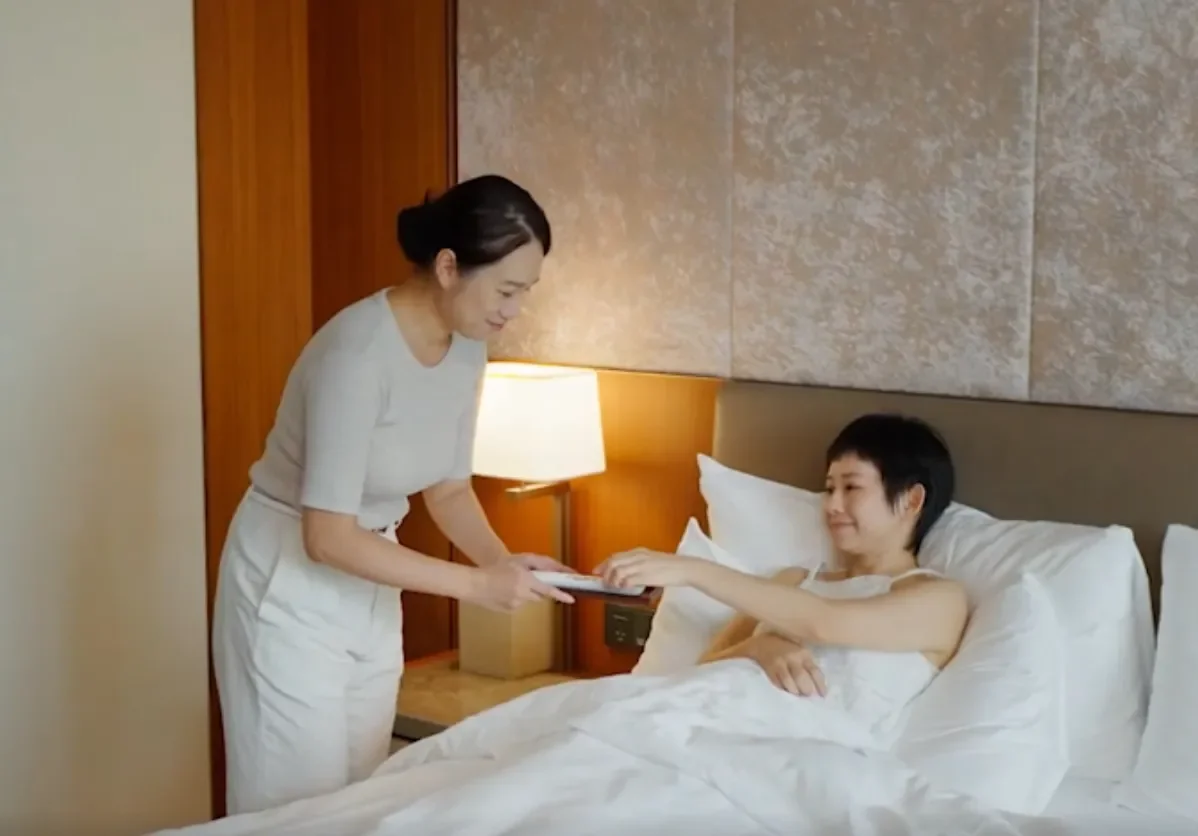
To help travelers relax and recover with dignity, "Far From Home Care" provides non-medical concierge support covering transportation, accommodation, meals, and specialized in-room amenities (Chang Gung Medical Foundation, 2022).
[Taipei Express Recovery Workflow]
Discreet Clinic Pick-Up ➔ Smooth Point-to-Point Transfer ➔ Fast Hotel Check-In Coordination ➔ Custom Meal Procurement ➔ In-Room Pampering Services ➔ Confident Return Home
1. Point-to-Point Private Transportation
Private vehicles wait at designated discreet clinic exits to transport you smoothly and safely to your hotel.
2. Hotel Check-In and Room Coordination
Your concierge coordinates with the hotel in advance to streamline check-in. Upon arrival, they assist with luggage, set up cold compress packs, and preserve your privacy so you don't have to strain your eyes over hotel logistics.
3. Meal Procurement Aligned with Preferences and Diet
Relying solely on food delivery apps can lead to meals that don't suit your appetite. Your concierge can run errands to purchase your favorite local Taipei dishes while aligning with your personal dietary needs and medical advice (such as arranging fresh fish soup or light, digestible options) (China Medical University Hospital Nutrition Department, 2024). You get hot, comforting food delivered straight to your room without needing to step outside with blurry vision.
4. In-Room Pampering Services (Turning Recovery into a Restorative Break)
Recovery doesn't have to mean being cooped up miserably in a room. To make your Taipei trip feel like a true restorative getaway, we assist in connecting you with professional in-room beauty partners (all services are fully customizable upon request during consultation):
- In-Room Professional Hair Washing and Scalp Care: Proper wound care is crucial after eye surgery. Professional stylists provide in-room hair washing while you lie back comfortably, keeping water away from your eye area.
- In-Room Manicures: Enjoy a relaxing nail treatment in the quiet comfort of your private hotel room.
When your short trip comes to an end, you can pack up effortlessly and fly home looking refreshed, polished, and confident.
Frequently Asked Questions (FAQ)
Is a private concierge and transfer service really necessary for a minor, minimally invasive under-eye procedure?+
Although under-eye surgery is a minor outpatient procedure, ophthalmic ointment and continuous cold compresses often cause temporary blurry vision, light sensitivity, and eye dryness during the first 48 hours (Pool et al., 2015; Chang Gung Medical Foundation, 2022). Operating a phone to hail a ride, navigating hotel amenities, or going downstairs for food pickup can be surprisingly exhausting when you're alone in an unfamiliar city. Private transfers and local support allow you to rest your eyes completely and return safely to your hotel without hassle.
Will private transfers and hotel check-in services guarantee complete privacy?+
Yes. Our concierges and drivers sign strict non-disclosure and privacy agreements. Clinic departures and hotel arrivals utilize discreet routes. Your concierge coordinates house logistics directly with the hotel staff, minimizing public exposure while you have bandages or swelling.
Can I request specific local Taipei dishes for meal procurement?+
Absolutely. Our procurement service is highly flexible. We prioritize your personal food preferences while incorporating clinical dietary recommendations, picking up high-quality local dishes or nourishing soups so you can eat well during recovery.
Can I arrange hair washing or beauty pampering during hotel recovery?+
Yes. We offer in-room hair washing (preventing tap water from touching surgical incisions; Chang Gung Medical Foundation, 2022), scalp relaxation, and in-room manicure services. All pampering options are fully customizable and can be arranged during your initial booking consultation. You can unwind comfortably in your room and return home looking and feeling your best.
What if I experience unexpected swelling or eye discomfort during hotel recovery?+
Our concierges provide strictly non-medical daily living support. If you experience any physiological concerns or questions about your recovery, your concierge will immediately act as a liaison to connect you with your surgeon's medical team and clinic staff.
References (APA 7th Edition)
Chang Gung Medical Foundation. (2022). Yanpi shoushu zhaohu xuzhi [Care guidelines for eyelid surgery] [Clinical educational leaflet]. Chang Gung Memorial Hospital. https://cgmhoph.org/wp-content/uploads/2022/11/%E7%9C%BC%E7%9A%AE%E6%89%8B%E8%A1%93%E7%85%A7%E8%AD%B7%E9%A0%88%E7%9F%A5.pdf
China Medical University Hospital Nutrition Department. (2024). Waike shoushu hou bingren zhi yinshi yuanze [Dietary principles for post-surgical patients] [Educational leaflet]. China Medical University Hospital. https://www.cmuh.cmu.edu.tw/HealthEdus/Detail?no=4788
Pool, S. M. W., van der Lei, B., & Melenhorst, W. B. (2015). The effect of eyelid cooling on pain, edema, erythema, and hematoma after upper blepharoplasty: A randomized, controlled, observer-blinded evaluation study. Plastic and Reconstructive Surgery, 135(2), 277e–281e. https://doi.org/10.1097/PRS.0000000000000891
Taipei Veterans General Hospital Nursing Department. (2024). Yanjing shoushu yu yanpishoushu hou zhi jujia zhaohu zhinan [Home care guide after eye and eyelid surgery]. Taipei Veterans General Hospital e-Health. https://ihealth.vghtpe.gov.tw/media/750